Sunday, March 14, 2010

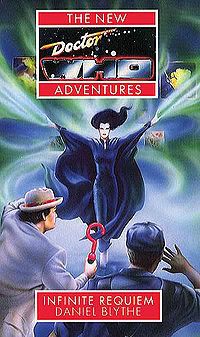
Infinite Requiem

A novel featuring the Seventh Doctor and Benny

Written by Daniel Blythe

Polarity Rating: 2 out of 5

The humans are at war with the Phractons on the planet Gadrell Major, where the conflict has razed the planet's cities to the ground. In the meantime, three strange and powerful people are exploring three different places in the universe, and all three are actually one omnipotent, powerful creature. All of this results in the Seventh Doctor and Benny finding themselves on Gadrell Major, amidst the conflict taking place and up against Shanstra, whose powers are culminating even as the war around her is coming to a bloody end.

Infinite Requiem is very well-written by Daniel Blythe, who was unfamiliar to me up until reading this book. The problem is that it brings nothing new or interesting to the table. Admittedly, I have been slacking off a little on posting these reviews, and I put this story down about a month ago, read another book and finished it, and picked up a third book before I sat down to write this review. I find myself in a fog, because there's little, if anything, memorable about this story.

The televised stories are rife with conflict between one alien race and another, or one colonized civilization and its unruly rebels. Sometimes it works, sometimes the story just fades into the woodwork. (Tell me what you can remember about "Colony in Space," for instance.) Infinite Requiem is a lot like that. We have a war between the human beings and the Phractons, a cyborg race who are all connected via a virtual electronic grid and house themselves in small flying pods; I was reminded of the Toclafanes in the contemporary Who stories "The Sounds of Drums" and "Last of the Time Lords." I liked the Phractons, and desperately wanted to learn more about them, but the story doesn't exactly pull us in that direction.

The antagonist is an ethereal being which has split into three separate entities, calling themselves Kelzen, Jirenal, and Shanstra. We see a lot of Shanstra, and learn that she can bend minds to make people do things against their will and pretty much do the standard stuff that any god-like omnipotent creature can do: you know, fly about, shoot energy bolts from her hands, that type of thing. Jirenal, definitely the most interesting of the group, makes his way to the Pridka Dream Centre, which is run by a race of psychic reptilians called, of course, the Pridka. The Dream Centre is another place I wanted to learn more about, but we are only treated to snippets of storyline from there in the first half of the book, and although the action culminates there in the end, the novelty has worn off and the Doctor's attempt to defeat Shanstra and prevent her from accomplishing the titular "infinite requiem" takes center stage.

I said earlier that this book had little, if anything, to remember it by, and I just remembered something. There's a glorious scene where Jirenal makes a young Pridka's head peel back and burst open before a white dove comes flying out of the corpse. Not that's the kind of cool powers I wanted to see more of. Also, the Seventh Doctor is up to his usual manipulative tricks, which gets him punched in the face in the end.

This sounds like a hated the book, but I didn't. I suppose the word "meh" would best summarize my feelings for it. Doctor Who seems to be saturated with stories about wars and villains who think they're gods. Naturally, it's all squared away by the Doctor in the end, and of course it's done in typical deus ex machina style. I find myself reading, listening, or watching stories that involve characters or concepts that are simply too complex for me to wrap my little mind around, like the Eternals in "Enlightenment" or the infamous "Ghost Light." Infinite Requiem was no exception. Perhaps it's just me, and if other fans enjoy this stuff, then more power to them!

Daniel Blythe began his writing career with Doctor Who and later moved on to better things. I wish him the best. He's obviously talented and can weave a good tale. I just hope he never comes near Doctor Who again.

Fun Facts:
  • Although the TARDIS' zero room was allegedly jettisoned in "Castrovalva," it reappears here.
  • Captain Cheynor appeared first in The Dimension Riders, also penned by Daniel Blythe. Blythe must not have liked him very much, as he pathetically kills Cheynor in the final pages.
  • There's a brief mention of the time-space visualizer seen in "The Chase." Apparently it's been recording all of the Doctor's adventures since its installment.

Friday, January 8, 2010

The Power of the Daleks


A televised story featuring the Second Doctor, Ben, and Polly

Written by David Whitaker and directed by Christopher Barry

Polarity Rating: 4 out of 5

Hot on the heels of the Tenth Doctor's regeneration in "The End of Time," we come to probably the least-seen regeneration episode of all time, a foregone conclusion if there ever was one because the BBC elected to toss out all six episodes of the story long ago.

"The Power of the Daleks" was a huge crap shoot for the BBC. After three years in the role, William Hartnell's ailing health forced him to leave the show, and the producers found themselves with a conundrum: how could they possibly replace the lead actor after he had established himself and been received so well? From the outset, the producers and the BBC elected rather than casting someone else to step into Hartnell's shoes, they would completely revamp the character in looks and personality.

Perhaps to offset the audience's trepidation about the change in casting, the producers elected to bring back the Daleks, who hadn't made an appearance since "The Daleks' Master Plan." And so David Whitaker penned a Dalek story that left out any elements of the Doctor's personality and called it "The Destiny of Doctor Who." Dennis Spooner was later asked to make some changes after Patrick Troughton was cast in the role and the crew had some idea of what the new Doctor would be like. It was show creator Sydney Newman's idea to make the Second Doctor a kind of "cosmic hobo," who is better at listening than speaking, a stark change to the verbose Sherlock Holmes that David Whitaker originally had in mind.

Nowadays we've seen the Second Doctor in stories like "The Mind Robber," "Tomb of the Cybermen," and "The War Games," but his characterization there is far from Sydney Newman's original idea. However, in this story, Newman's decsription of the character is spot-on: the Doctor spends little or no time stammering in protest or talking excitedly, and seems to ignore the questions of his companions (or does he?). Although it's difficult to gauge without seeing the visuals, he seems to be thinking more than doing, and he spends much of his time thinking while playing a recorder. There are little bits of playfulness that shine out in Troughton's performance, such as when he's listening to a piece of fruit or confusing china plates with the country of China (listen for a reference to a classic Hartnell story there).

Fans must have loved the Daleks after their initially appearance in 1963, but nowadays fans have a bit of a love-hate relationship with the Doctor's most famous enemy. One has to admit that they're a big stagnant visually, the sound of their voices tends to get a bit too repetitive half an hour into the story, and the writers have evolved them over the years into miniature war machines that can fly through the vacuum of space. On the other hand, the Daleks are an institution in England, and even casual viewers can recognize them. If the current producers failed to include a Dalek story in every season, I think they would have a minor coup on their hands.

With that in mind, I have to admit I approached this story as "just another Dalek story," and was looking forward to the opening regeneration scene rather than the remaining five and a half episodes. However, Whitaker really delivers a smashing good Dalek story, and we get to see them in a light we've never seen before; they're no longer the ravaging killers we saw in "The Dalek Invasion of Earth," but suspicious characters that lurk in the background for much of the story, causing both the listener and the Doctor much vexation.

The setting of the story is pretty standard fare. The Doctor, Ben, and Polly arrive on the planet Vulcan amidst yet another colony of earthlings. Among them is Dr. Lesterson, the archetypal scientist who is focused on nothing but his work, that being opening some kind of capsule discovered in the planet's mercury swamp. There are also rebels in the midst of the colonists who wide like to use Lesterson's work for their own purposes, particular when the capsule is opened and a Dalek emerges.

For once, however, the Dalek is not bent on blasting everyone in its wake. It seems willing to serve the colonists and eerily keeps repeating "I am your servant," in monotone Dalek fashion. The Doctor, of course, knows there's more to it than meets the eye, as do we. Even Ben and Polly seem to be taken in, no doubt because this is their first encounter with the Daleks. Of course, by the story's conclusion, the Daleks' true intention of using the colonists' power supply to build new Daleks becomes all too apparent and many, many people die.

There are moments in "The Power of the Daleks" that stand out in one's mind (spoilers ahead!). For instance, at the first episode's cliffhanger, the Doctor is assaulted by a Dalek creature which has crawled out of its casing. Viewers got to see only a glimpse of a Dalek claw in their premiere story, but seeing this for the first time must have been thrilling. Imagine it: not only is the Doctor being played by a new actor, but we get to finally see what a Dalek looks like under all that metal! In another scene, Lesterson accidentally uncovers the Daleks' plan when he's exploring the interior of the capsule. He sees a literal Dalek assembly line, with machines placing the tentacled creatures into their robot casings.

As a fan, listening to these scenes is enjoyable on two levels: it's a visual leap for the history of the show, but also the shock and joy of hearing the Daleks' plan unfold is far better than any of the Dalek revelations served up to us in the current story. Pure gold. We all know that something is going on in that capsule we just don't know what, and we're as anxious as the Doctor to discover it.

If one would have to say anything bad about this story, it would perhaps be the length. At six episodes, there is a little bit of padding in the middle, much of it involving the rebels plan to usurp the colony's governor. There are also maybe one too many classic scenes involving running up and down corridors. Ben and Polly also seem to take a backseat to the action, and they've conveniently captured and held hostage by the rebels, perhaps so the actors could take a break (Polly is absent from the fourth episode and Ben is absent from the fifth).

As with "The Enemy of the World," perhaps the story is better without the visuals; I can only imagine how boring the colony hallways must have looked. Nevertheless, any Doctor Who fan would admit that it would still be a real treat to actually see "The Power of the Daleks."

Fun Facts:
  • The BBC's account books, which still exist, say that this story cost a total of 17,065 pounds. What I find baffling is that the beeb actually threw out the films but elected to keep the books. There's bureaucracy for you.
  • Although the story is now available on CD and presented by Anneke Wills, it was originally released on cassette in 1993 and presented by Tom Baker.

Thursday, December 24, 2009

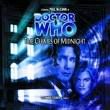
The Chimes of Midnight

An audio adventure featuring the Eighth Doctor and Charley

Written by Rob Shearman and directed by Barnaby Edwards

Polarity Rating: 3.5 out of 5

Imagine my festive frivolity when, randomly choosing my next Big Finish production to review in mid-December, a story presented itself that was set on Christmas Eve. Not only that, but the blurb on the back of the CD suggested it was some kind of Edwardian murder mystery. Sign me up, I said, and quickly went about listening to it so that I could post my review on this very day, Christmas Eve itself.

A quick word about Christmas stories and Doctor Who. When a story is set on Christmas, it never is about Christmas per se, but rather it involves some kind of an alien invasion set on Christmas Day (one obvious exception is the single episode aired on Christmas Day for "The Daleks' Master Plan," which I have not yet had the pleasure to listen to). There may be robot Santas wielding laser guns and a festive holiday party about to be torn to shreds by a tragedy a la The Poseidon Adventure, but I would love to see or hear a story that involves the concept of Christmas itself as a basis for the plot. (I would refer anyone seeking such a story to the recent Iris Wildthyme adventure, The Claws of Santa, which really hits the nail on the head in this department.) Such is the case with The Chimes of Midnight. There is a great deal of talk about Christmas pudding, one or two carols are sung in passing, but other than that the thing could have been set on Saint Swithen's Day and we would have had the same story.

Not that I have any huge gripes with most of the story. When the TARDIS materializes in the pantry of a country estate in 1906, the Doctor and Charley are involved with the comings and goings of five members of the household staff. Strangely, nothing is heard from the gentry having a Christmas party upstairs, and indeed when the Doctor tries to ascend to the upper levels of the house, he is deterred with unexplainable and uncharacteristic threats of violence from the staff. It's not long before a murder occurs and, in true Ten Little Indians fashion, the staff begin to be bumped off one by one, each at the grandfather clock's striking of the hour: the scullery maid, for instance, is found drowned in the washing basin, and the cook is found sprawled across the kitchen table, force-fed her infamous Christmas pudding to death. These events may seem like spoilers, except that the same characters inexplicably show up minutes later alive and well, oblivious to the fact that they were found murdered moments before. The Doctor and Charley and the listener, of course, are baffled.

This was the perfect setup for a wonderful cosmic mystery. Why are the characters admittedly unsure whether or not they could be the murderer? Why do the household duties of each of the characters change every time they return from the dead? Why do they recognize the Doctor as some kind of famous amateur sleuth? Through the first three episodes, I thought I had it all figured out: of course, I figured, the Doctor and Charley were stuck in some sort of land of fiction as in "The Mind Robber," where an author of whodunnits was constantly rewriting a draft of his latest murder mystery, never quite sure who the proper murderer should be in the end or even the right victim.

My solution, needless to say, was not the correct one. Unfortunately, the true solution to the mystery would have led me to give this story a 4.5 rather than a 3.5 if it didn't leave me scratching my head. I suppose there are fanboys and fangirls out there who love stories involving paradoxes and time folding in on itself, but these type of stories rarely work for me unless they're spelled out for me like I'm a nine-year-old (the old favorite "Blink" comes to mind). In all fairness, I could go back and listen to the last episode, but I just don't think that would be proper. Why go back and listen to a story and purposely look for the good things when the writer and/or director failed to get the point across the first time?

I rarely think this when listening to Big Finish stories, but this one would have been a wonderful televised story for Christmas Day. There were certain passages here that would have translated better on the screen, and the holiday element could have been used a bit more than it was. If Paul Cornell could translate his novel Human Nature so well on to the screen, I say let Rob Shearman have his pick of a few audio adventures, definitely including The Chimes of Midnight, and see what magic he can make of those. He is, after all, the writer who brought us Dalek, for some the epitome of the perfect Dalek episode in the new series.

If you're new to Big Finish (or to the Eighth Doctor adventures), I'm told by folks on the forums that The Chimes of Midnight is one of the best out there. I beg to differ. Pick up a copy of Sword of Orion or Storm Warning instead. Unless, of course, you're one of those fans who love to put the 10% of the missing pieces of a puzzle together yourself. In that case, perhaps you have a better imagination than I and more power to you.

Fun Facts:
  • The character names for Shaughnessy, the butler, and Mrs. Baddely, the cook, were derived from the names of the script editor and the actress who played the cook in the classic British show Upstairs, Downstairs.
  • These are not the only characters to glean inspiration from Upstairs, Downstairs; Edith, the scullery maid from The Chimes of Midnight, bears a striking resemblance to the feather-brained scullery maid Ruby in Upstairs, Downstairs.

Monday, December 14, 2009

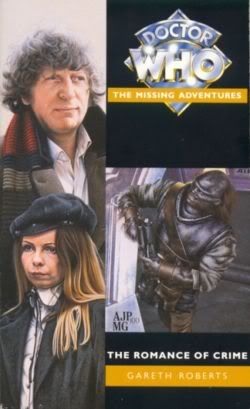
The Romance of Crime

A novel featuring the Fourth Doctor, K9, and Romana II

Written by Gareth Roberts

Polarity Rating: 4 out of 5

Season 17 is arguably the worst period of the Fourth Doctor's era, what with the uninspired "Destiny of the Daleks" (did we really need to see Davros again?), the boring "Creature from the Pit," and Doctor Who's failed attempt at pantomime in "The Horns of Nimon." I imagine Gareth Roberts truly wanted to challenge himself by writing a novel set between those aforementioned stories, or perhaps he's a fan of season 17 and just wanted to celebrate it. In any case, The Romance of Crime somehow feels like a season 17 story, except it turns out to be much better than most of the stories in that very season.

The flavor is in the description of the characters, with guards that wear red frockcoats, a judge who, if he had been portrayed on television, would have chewed the scenery to bits, and villains that seem like hilarious caricatures of some of the more forgettable baddies in Doctor Who's long history. The flavor of this era of the program also can be read in the description of the setting, a space station with meandering corridors in which the characters inevitably run back and forth in. And, perhaps best of all, the portrayal of the Doctor and Romana is crafted straight from the late era of the Fourth Doctor, with the usual banter between the two of them. Take, for instance, this quote from the Doctor as he barges into a control room filled with villains:

"Hello everybody. It's nice to see you again, Xais, and you Mr. Pyerpoint, and you charming Ogron gentlemen, and, ah, you must be the Nisbett brothers. You don't know me, I'm the Doctor, this is my friend Romana, and that's Mr. Stokes, and do you know unless you listen to me I think we're all going die."

It's as if Gareth Roberts was actually channeling Tom Baker. Try having any one of the other ten actors that have played the Doctor say that line, and it wouldn't feel right at all, not even if David Tennant gave it his best.

Most of the story unfolds aboard the Rock of Judgment, a space station which cruises the galaxy and functions as both a kind of galactic courthouse and prison. The captain, for lack of a better word, is a judge named Pyerpoint, who spends the first half of the story trying to keep order in true bureaucratic fashion after the Doctor and Romana arrive. The Rock is home to a number of interesting characters, including security chief Margo, who seems to suffer from erratic bouts of possession from forces unknown, and Menlove Ereward Stokes, the resident artist and winner of this story's most eccentric name. (Stokes spends much of the story cowering behind corners, whining about every situation he finds himself in, and trying unsuccessfully to hit on Romana. He reminds me very much of a heterosexual version of Dr. Smith from Lost in Space.)

We soon learn that Margo is slowly being taken over by the spirit Xais, an evil female mutant who had been executed at the Rock years earlier for slaughtering dozens of non-mutants, whom she calls Normals. Xais can kill human just by looking at them, but they don't just drop dead; they literally fold in on themselves in a grisly display of flesh and bones. Xais has her own allies, the Nesbitt brothers, intergalactic gangsters who look like Drew Carey and act like Gordon Ramsey. Oh, and the Ogrons make an appearance as well, and Roberts handles them much better than they way they were portrayed in "Day of the Daleks" and "Frontier in Space." (No spoliers there -- there's a drawing of an Ogron on the front cover.)

What Xais has planned I will not tell you. What I can tell you, however, is that it involves a number of allies and a tangled web of deviousness that I relished reading. What results is a typical "base under siege" story, with characters being split up, reunited again, and split up again into different combinations. Of particular note is K9's role in the story as he accompanies a rough undercover police agent who ends up taking a shine to the tin dog.

Xais' evil plot aside, the main attraction is reading about these characters rather than the way the story moves. Perhaps the plot itself is the story's weakest link, as it's all pretty straightforward, but it's the tasty ingredients in the story itself -- namely, the characters -- that make this stew particularly good.

This was Gareth Roberts' fourth novel for Virgin's Missing Adventures series (the first three were Seventh Doctor New Adventures) and he went on to pen a handful more and wrote three scripts for the new series, namely "The Shakespeare Code," "The Unicorn and the Wasp," and "Planet of the Dead." All three of these scripts lack much of the humor and rib-poking that fills The Romance of Crime (with some exceptions, particularly in "The Unicorn and the Wasp"), and I'm hoping that his upcoming installment for the Eleventh Doctor brings some of this back. He was certainly an asset to the novels published by Virgin, and I look forward to reading more by him.

Fun Facts:

  • Roberts brought the large, eccentric, and bald artist, Menlove Stokes, back in The Well-Mannered War and he later became a regular in the Benny New Adventures.
  • For this first time (I think) we're told that the Ogrons are from the planet Braah, where drastic changes in the climate caused the Ogrons to undergo an evolutionary hiccup. As a result, they're not unlike a cross between an ape and a koala bear.

Tuesday, December 1, 2009

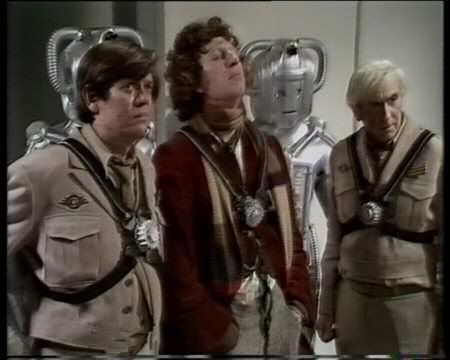
Revenge of the Cybermen


A televised adventure featuring the Fourth Doctor, Sarah Jane, and Harry

Written by Gerry Davis and directed by Michael E. Briant

Polarity Rating: 2 out of 5

Long before Star Trek: The Next Generation presented us with the Borg, two wily chaps named Kit Pedler and Gerry Davis sat down to create the race of alien villains for the First Doctor's final story, "The Tenth Planet." There's no record or citation for this, but I am willing to bet that they wanted something fairly less banal than Terry Nation's Daleks, which had taken the country by storm three years previously. Pedler and Davis' Cybermen could walk up and down stairs, perform tasks that required appendages, and withstand extreme climate changes without needing a special floor to provide static electricity. As the canon progressed, we learned that Cybermen are also allergic to gold dust and, perhaps creepiest of all, use unwilling human subjects to create more Cybermen. (This last feature was exploited in "The Tomb of the Cybermen" and rather disturbingly in Steve Lyons' novel Killing Ground, and totally eliminates the need for any Cyberwomen. Hear that, Torchwood?)

Prior to "Revenge of the Cybermen," the villains had made a handful of appearances during the Second Doctor's era but never lifted a silver-gloved finger to pester the Third Doctor. Season 12 presented the audience with a four-story arc involving the transmat system to and from Space Station Nerva: "The Ark in Space," "The Sontaran Experiment," "Genesis of the Daleks," and finally "Revenge of the Cybermen." Upon viewing, it's no surprise that "Revenge" rounded out the end of the season, when the production crew will look for ways to cut the budget wherever possible. The sets are borrowed from "The Ark in Space" (although not to the story's detriment), most of the costumes look like they were slapped together with tin foil, the special effects are laughable, and the alien effects are unconvincing. Suffice it to say that the actors all tend to pull it together at the end of the day, although I cannot say the same for those that penned the story.

Ah yes...the story. Although I will go on about that in a moment, I should add not all the blame must be laid on Gerry Davis; he thrilled us so well with "The Tomb of the Cybermen." I was shocked to learn that none other than Robert Holmes was responsible for many of the blemishes in the story; after reading Davis' story, as script editor Holmes made a number of changes, including adding the unbearable Vogans.

But let's not get ahead of ourselves. This is after all, a Cybermen story, so surely the creators gave the much-missed aliens something clever and cool to do after their long hiatus following "The Invasion." (A word of warning: As this story has yet to see the light of day on DVD, I'm a little hesitant to reveal a lot, but I simply cannot bring myself to criticize this episode without revealing a lot of details, so spoilers abound.) This time around, after recovering from their war with the Vogans, whose world is made up entirely of gold, a small crew of Cybermen are making their way towards the Nerva Beacon, which thousands of years later would become Space Station Nerva in "The Ark in Space." The Cybermen have spearheaded their visit with the help of a human ally, Professor Kellman, who has planted a number of adorable Cybermats on board the beacon; the Cybermats have bitten and killed 46 people aboard the beacon since their introduction (plus one more just after the Doctor and his friends arrive), and the crew has mistaken this for some sort of space plague.

So far so good. Once the Cybermen arrive, they plan to capture the three remaining humans left alive on the beacon (excluding Kellman), strap bombs to their bodies that look not unlike bowling balls, and then force them to transmat onto Voga where the bombs will "fragmentize" (the Cyber Leader's word, not mine) and destroy the gold-enriched planet. One assumes, therefore, that the Cybermen feel they'll be safe as houses because Voga is the primary source of gold in the galaxy, which is a contentious point but not particularly bothersome to me.

The Vogans, on the other hand, have their own plans. Kellman, it turns out, is really a double-agent working with the Guardians (a rebellious warrior faction of the Vogans), who have spent two years building a rocket ship (which, by the way, bears a strange resemblance to a NASA spacecraft, as well as the rocket in "Genesis of the Daleks") which will be aimed to strike Nerva Beacon at the precise moment all the Cybermen are aboard, thus ensuring the safety of Voga and proving the love of the Vogans for their children at long last.

So herein lies the problem that I couldn't get the fuck out of my mind while watching this story. The Cybermen have a space ship and bombs. The Vogans live on a big meteor made out of gold, and it appears that their only advances have been interior decorating, spelunking, and tram-building. Yet the Cybermen lack the technology to build a big goddam missile that will blow Voga to shit, and the Vogans have pulled this giant rocket out of their green asses, albeit they did it in two years. Hello, Robert Holmes, anyone home?

On top of it all, not unexpectedly the Doctor foils the Cybermen's plans, at which point they begin to execute their "alternative" plan: crash the Nerva Beacon into Voga, but not before escaping in their own ship. Why didn't they just show up, kill the remaining four humans, then nose-dive the beacon into Voga in the first place? Someone really needs to sit down with the Cybermen in the local IHOP and explain to them that complicated plans are not necessarily the best. This plot, compared to their Rube Goldberg plan in "The Moonbase," simply makes the mind boggle, although it apparently bears some credence to a Cybermind.

As for the design of the Cybermen themselves, I have no idea why the production team thinks it should be changed every time they make an appearance. This new design is not a vast improvement of that in "The Invasion," nor is it really any worse than the later appearance the Cybermen would make in "Earthshock." And the sound effects people simply lost the memo on how to make the Cybermen talk, since what we have here are some actors talking loudly inside their helmets; gone is the creepy computerized voice we hear in every other Cybermen story.

The design of the Vogans is a dismal failure. They look like William Hartnell mated with a Klingon, and the actors themselves fail to make the aliens plausible. The effects crew has done better in previous seasons with races such as the Draconians, and I saw no need to make the Vogans anything more than humanoid.

But it's not all bad. The chemistry between the Doctor and his companions is as fun as ever, particularly between him and Harry ("Harry Sullivan is an imbecile!"). It's a shame Harry left the TARDIS crew in the story after this one, as watching the banter between him and the Doctor would have been a joy to behold. Jeremy Wilkin as the sneering Professor Kellman also makes a good turn, and I was sorry to see him bludgeoned to death three-fourths into the story (killed by a rock fall accidentally caused by Harry, no less).

Another fun bit in this story, as is often the case, is Tom Baker's performance. After the Cyber Leader forces the Doctor to strap on a bomb and explains his plan to destroy Voga, Tom Baker lets loose with a monologue reflecting his utter disrespect for the Cybermen, most memorably calling them something like "silver-plated structures used by people to hang their hats on." Fun, fun stuff.

Where "City of Death" was a diamond placed in a season among a shitpile of abominations, "Revenge of the Cybermen" is just the opposite: a turd sitting in the fragrant garden in which the rest of season 12 seems to bloom forever.

Fun Facts: Look closely at what the Vogans are using for decoration in their gallery/control room. Doesn't that piece of art bear a striking resemblance to the seal of Gallifrey? Also, this story marks a point in Doctor Who history as the first one available on VHS (you can now purchase it on ebay for anywhere between $11.99 and $20.00). As of this writing, it has not been released on DVD, and I wouldn't hold my breath. Apparently, I am not alone in my lack of enthusiasm for this story; in October of 2009 the readers of Doctor Who Magazine ranked "Revenge of the Cybermen" 13o out of the 200 current stories.

Sunday, November 29, 2009

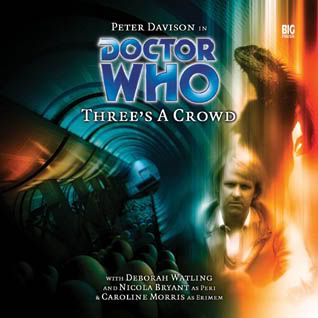
Three's a Crowd


An audio adventure featuring the Fifth Doctor, Peri, and Erimem

Written by Colin Brake and directed by Gary Russell

Polarity Rating: 3.5 out of 5

After listening to this story, I really have to admit that there was nothing particularly extraordinary or original about it. There's a stranded colony of earthlings, a lot of people getting separated and running up and down corridors, and elements of the story seem to have lifted directly from films like Alien and The Island. All that being said, I still have to admit that it has everything that a halfway decent Doctor Who story has, and I have to laud it on that fact alone, as so many of the Big Finish stories seem to try to do something new and innovative and fall flat on their face (Minuet from Hell comes to mind).

The setting is space station Earth Colony Phoenix, stranded in space and cut off from the home planet, still attempting to terraform the unnamed planet below. The station itself is apparently huge, but houses a minimal number of colonists, and all of them are forced to live in solitary living quarters, never mingling with more than one other colonist at a time. The colony seems more like a prison ship, with the colonists suffering from severe agoraphobia (thus the title). Earth Colony Phoenix is headed by a woman named Auntie (perhaps hearkening back to Mother from Alien?), and she is played with steely coolness by Deborah Watling, whom most of us will know as Victoria during the Second Doctor's era. Ms. Watling has changed quite a bit over the years, and when I saw her hosting one the documentaries on missing episodes as part of the Lost in Time boxed set, I was taken aback at how stoic and somehow cruel she seemed, not unlike a poor man's Anne Robinson.

But I digress. The Doctor and his companions arrive as usual (with Erimem still feeling a bit of angst left over from their last adventure), and we learn that, unbeknownst to most of the colonists, Space Station Phoenix has been infested by a lizard-like alien race called the Khelllian (three L's, that's not a misspelling). The infestation becomes apparent when the TARDIS crew comes across a room filled with large slimy eggs; look closely at the CD cover art and you can see them. Again, inspiration from Alien looms.

I will not tell you what the Khelllian are up to and why they are being aided by Auntie, but the cliffhanger at the conclusion of the second episode is spine tingling; I really didn't see that one coming! There are three other colonists we meet: Bellip, Laroq, and Vidler, and they're pretty much indistinguishable except for the fact that Bellip is a high-strung female and Vidler seems to be a little more headstrong. The three characters were likely added to the mix to provide company to Peri and Erimem, who almost instantly break away from the Doctor and are involved in their own subplots. (There's also an insipid little romance between Bellip and Laroq, but this subplot seems a little forced and pads the story to its detriment, although it is helpful to understand the isolated lives the colonists are living.)

I have listened to about 25 Big Finish stories so far, and while Three's a Crowd doesn't stand out as one of the best, I really cannot say many bad things about it. Again, the lack of originality didn't seem to bother me, since this formula has worked so well in episodes like "The Ark in Space" and "The Macra Terror." I can say that the second half of the last episode was rushed and confusing, with all of the characters struggling to arrive at a fixed point while a time bomb counted down the seconds. How some of them survive eludes me (the story relies a little heavily on the convenience of transmat technology), and there's a final scene involving a hidden explosion that seems a little tacked on, but the resulting squishy sounds effects that were fun.

Deborah Watling is chillingly wonderful as Auntie, Peter Davison gives an adequate performance as the Doctor, and Nicola Bryant outshines her television performances as Peri. Caroline Morris as Erimem is a true joy, however, and I look forward to listening to more adventures with her. I've only listened to one Erimem adventure (The Eye of the Scorpion, her first one) and look forward to hearing more. She seems to be a carbon copy of Leela from the classic series, but it's fun to listen to her interact with Peri rather than just stick in her in the TARDIS to let the Doctor do his Professor Higgins magic again. Also, to my knowledge this is the only story in which the Doctor presents one of his companions with the option of staying behind to help the survivors and she turns him down, preferring a life in the TARDIS.

Kudos also goes to Gary Russell, who did a fine job recreating an eerie, desolate space station. Russell has come under fire from some fans for his lacklustre writing and his insistence on bringing back old villains, but I've enjoyed almost everything he's done for Doctor Who.

Three's a Crowd would be a great recommendation for Big Finish fans, and I am tempted to recommend it to fans who don't listen to the audio adventures because it hearkens back to the classic series so well. Just don't eat anything while you're listening to it.

Sunday, November 22, 2009

The Eleventh Tiger

A novel featuring the First Doctor, Barbara, Ian, and Vicki

Written by David A. McIntee

Polarity Rating: 3 out of 5

I've never been a very big fan of the historical epics during the First Doctor's era, so it was with trepidation that I opened The Eleventh Tiger. However, my fears were quickly allayed: the prose is descriptive and the characters (particularly the four regulars) are well-realized. McIntee uses masterful brush strokes to recreate China in 1865, and I was almost instantly sucked in.

But first, a bit of history. In 1865 China was still recovering from the Opium Wars, in which they lost to the British and were forced to tolerate the British occupation as they traded freely in opium and other goods. Among other things, China also ceded Hong Kong to the British. In the background of all this was a league of bandits known as the Black Flag Army, whose primary ambition at the time was to oppose the British. It's the Black Flag Army that's the catalyst of this story, although we later learn that, as usual, there are otherworldly powers pulling the strings.

As colorful as the book was, it dragged out for a bit in the beginning after the main characters are introduced and we discover that there's a British soldier in the city of Guangzhou who bears an uncanny resemblance to Ian. Did Ian return in the future? And why does this soldier not remember anything about his own life? The mystery is pretty compelling, since we all know he and Barbara eventually returned to their own time. But more on that a bit later. The story appeared to be taking the turn that most of the historicals did, with the TARDIS crew involving themselves in some tumultuous past event. Until, that is, we meet the abbot who is gearing up to take over the Black Flag Army. And the guy literally plucks out the eyeball of a dead deer and pops it into his mouth like a grape, but not before he orders one of his henchmen to cut off the nose and tongue of an allegedly insolent minion. And with this passage, the story takes a turn for the better.

Well, not all that better. McIntee's writing style continues to shine, and there are some absolutely fabulous passages with descriptions of hand to hand combat; this guy would have been an awesome choice to write a novelization of Kill Bill. There are some creepy terracotta soldiers that are possessed by alien energy and run amok, and the celestial activity leading up to the villain's master plan cause energy stored in rock to create images of ghosts. (Female ghosts, it should be noted, with long black hair that weep for dead lovers. I see some influence from the film Ringu in there somewhere.)

And then, dear reader, after a climactic scene in which Ian is going to shoot his future self to save Barbara's life, the story just takes a complete nosedive. We learn the story behind Ian's body double, and it's one of the most contrived plot points in recent memory. After leading us down the garden path for pages and pages, making the reader wrack his brains to figure out why a future Ian is in China in 1865 and why he's suffering from amnesia, we learn (spoiler alert!) that the "future" Ian is actually the "real" Ian's great grandfather. And they look like twin brothers! This has absolutely nothing to do with the alien menace lurking throughout the rest of the story and served only to insult the intelligence of the reader.

I have no complaints about McIntee's portrayal of the First Doctor, which is spot-on; there's a wonderful scene in which he engages in hand to hand combat that I could easily play out in my head despite the Doctor's obvious frailty. This is also the first novel, to my knowledge, in which we get to read about the inevitable affection between Ian and Barbara, and they even snog at one point. It was a bit of a shock, but ultimately quite understandable (particularly since they eventually marry, as we learn in The Devil Goblins of Neptune). Vicki seems a little under-utilized, as she spends most of the story hanging about in the background and developing a crush of her own on a local boy.

At the end of the day, the alien menace is vanquished and our heroes leave in the TARDIS. Unfortunately, the ending just seems a tad bit forced, as the solution to the problem appears out of nowhere. I do forgive McIntee for that, as the rest of the novel (sans the bit with Ian's double) is quite good.

Great writing or not, The Eleventh Tiger is not McIntee's best; he thrilled the socks off of me years ago with The Dark Path and impressed me again with The Face of the Enemy. But, particularly if you're a fan of the historical stories, you can't really go that wrong with this book. It beats the hell out of Sick Building anyway.