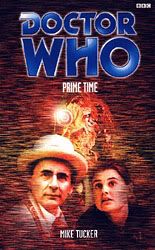
 A novel featuring the Seventh Doctor and Ace
Written by Mike Tucker
Polarity Rating: 4.5 out of 5
As Doctor Who fans, we all have a kind of checklist that every good story should adhere to. Of course, one person's treasure is also another person's trash, so the fan who is totally into Rose and the Doctor slash fiction may have a completely different checklist than, say, your atypical fan who would like to have a common law marriage with "Pyramids of Mars" whilst categorizing "Time and the Rani" as something equal to or less than pond scum.
That being said, Prime Time managed to tick of every item on my own proverbial checklist. It has everything. It's a story so unbelievably perfect for Doctor Who that I think Mike Tucker should immediately be commissioned to pen the script for the current series. I simply cannot understand how I've read so much of the BBC's literary canon that this one slipped by me unnoticed all these years.
To wax eloquent about a story is one thing, and it would probably make for a boring review simply to do so for several paragraphs, so back to that checklist I was talking about earlier. Let me share with you the items on my fanboy checklist, and explain how this story delivered each item in spades. (For the record, the list below is not exhaustive by any means.)
1. The Totalitarian Society
The Doctor and Ace find themselves on the futuristic planet Blinni Gaar, where all does not quite seem as it should. The inhabitants (a melting pot of races) are a little too engrossed in watching television. TV's are everywhere: installed at the foot of bed frames, into dinner tables, and even into the dashboards of automobiles. For this society, television is the opiate of the people.
The term "totalitarian" commonly conjures up visions of a ruthless government, usually with some greedy dictator pulling the strings. No mention is ever really made of Blinni Gaar's government, and it's not even clear that they even have a government. But who needs a government when the people are clearly hypnotized by lousy reality television? This is a totalitarian society of a different color, and it's obvious to the Doctor moments after stepping out of the TARDIS that things on this planet are just not normal.
2. The Ruthless Despot
Tobias Vaughn. Harrison Chase. The Marshal of Solos. Where would we be without them? Some of them command a small regiment of heavies, others entire armies. The best of them serve as figureheads for the stories they appear in. (Am I the only one who thinks of Tobias Vaughn as the main villain in "The Invasion" instead of the Cybermen?) On Blinni Gaar, they have Lukos Vogol, Director of Channel 400, which is responsible for transmitting many of the programs which are transforming the viewing audience into couch potato zombies.
Vogol is a maniacal megalomaniac, intent on getting the highest ratings by hook or by crook, including murdering every member of the geriatric board of directors. He occupies an office at the top of the Channel 400 studios, drinking scotch and watching television programs while manipulating everyone around him. This sounds like a typical villain, until about halfway through the story we learn this guy is hatching plans with as many layers as an Outback Steakhouse Blooming Onion.
3. The Brutal Heavy
Vogol is working with the Zzinbriizi, a barbarian race of wolf men who have been surgically augmented with superior intelligence. These guys can usually think for themselves thanks to their new abilities, but their hunger for blood and instinct to hunt is often overpowering. They find themselves stuck between obeying orders (from more than one master) and their need to eat flesh.
Had this been a mediocre story, the list of baddies would stop at the Zzinbriizi, but it's clear from the beginning that they're only pawns in a complicated power struggle between Vogol and...
4. The Terrifying New Alien Race
If I were to bring up the highlight of this book, it would have to be the Fleshsmiths. They are the stuff of nightmares, and if this story ever was televised, the Weeping Angels would probably take the back seat to these guys. Once a happy, normal race, the Fleshsmiths' planet suffered a natural disaster which forced them to kidnap members of other races and cannibalize their body parts to create new bodies of their own.
If one were to make a science fiction remake of The Texas Chainsaw Massacre, the sets would be not unlike the Fleshsmiths' home planet. Author Mike Tucker goes into some detail into their flesh bank, where bodies are left mutilated, hanging, and still alive from hooks and chains. The Fleshsmiths themselves stay connected to their external resources via thick tubes that are grafted into their bodies. The tubes are filled with murky black liquid, and one could almost smell the stuff as it's described how it oozes from the pipes as they're connected and reconnected to their hosts' bodies.
The Fleshsmiths' prime directive is simply to survive, even if it means other races have to die - and suffer horribly - in the process. Their directive is a simple one that we've seen over and over, but their realization is unbelievably gruesome. Perhaps their cruelest scheme is to kidnap an innocent soul, surgically implant a camera into his skull (among other things), and force him to do any of a number of things against his human conscience. Tucker leaves the appearance of this creature to our imagination, and the most we get are the first impressions from anyone encountering this crime against nature.
5. A Great Realization of the Doctor
The Seventh Doctor is perhaps best known for being cunning and manipulative, even with his own companions. But how does he react when the shoe is on the other foot? Here the Doctor becomes a mouse inside a giant maze, forced to deal with one deadly reality after another. There even comes a point when his enemy gloats over the Doctor's inability to plan his way out of the situation.
Of course, without revealing any major spoilers, the Doctor turns the tables at the end. In Prime Time, though, we see him at both his most vulnerable and eventually his most manipulative.
6. A Vulnerable Companion
And speaking of vulnerability, Ace is not the bat-wielding force to be reckoned with that we've seen in the final episodes of the classic series. She comes off as expected as first (she befriends another young citizen of Blinni Garr who teaches her how to rock climb), but eventually she finds herself in the clutches of the enemy and is forced to endure torment about her past and her future.
I will not say more about what Ace does in this story, but Tucker bookends the story with an epilogue and prologue regarding Ace that are cryptic yet compelling. I'll be damned if I saw that coming.
7. A Recurring Villain
Recurring villains are not my favorite. Why read another Dalek story when we can get something fresh and interesting like the Fleshsmiths? It would probably ruin the first third of the story if I told you the identity of the villain here, but suffice it to say that it's the most shocking revelation of a returning enemy since Lawrence Miles' Alien Bodies.
And there you have it. Prime Time is a thing of beauty, a wonderful feast with all the perfect courses and ingredients. Perhaps its only problem (and the reason I didn't rate it a perfect 5) is that Mike Tucker's prose is a bit off when it comes to describing places and things; I found myself having to reread some passages, then forged on in slight confusion nevertheless because I couldn't get what he was trying to get across visually (the description of the Fleshsmiths notwithstanding).
If you're a Who fan with an internet connection and $15 in your bank account, there are far worse things you can spend it on. Undoubtedly one of the best Missing Adventures in recent memory.
Fun Facts:
- If the name Mike Tucker sounds familiar, you're not mistaken. Aside from writing a number of Doctor Who novels (most of them featuring the Seventh Doctor), Tucker is known for his effects work for some of the Ninth Doctor's televised stories.
- Prime Time is riddled with in-jokes regarding the history of Doctor Who. For instance, while promoting the idea of broadcasting a show featuring the Doctor, Vogol labels him a "cosmic hobo," a term often used to describe the Second Doctor.