Showing posts with label Eighth Doctor. Show all posts

Thursday, April 1, 2010

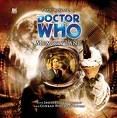
Memory Lane

An audio adventure featuring the Eighth Doctor, Charley, and C'rizz

Written by Eddie Robson and directed by Gary Russell

Polarity Rating: 4 out of 5

After listening to my somewhat scathing podcast review of "The Keeper of Traken," a friend suggested that I watch something that was more of a "romp," perhaps something with Daleks. I was inclined to be offended, but then I reviewed my recent writ-up of Infinite Requiem (see below), and now I can't help but think the time is ripe for such a "romp." Memory Lane turned out to be a happy respite.

The Doctor, Charley, and C'rizz (pronounced "care-rizz") dematerialize in a typical English urban neighborhood, but of course everything is not as it seems. Each one of the homes along the seemingly deserted street is occupied by the same elderly woman and her grandson Tom. Why does Tom look much older than he acts? Why does his nan not seem to blink an eye when the TARDIS materializes in her parlor? Why do the same programs play over and over again on the telly? And why does the ice cream man seem so sinister?

By the time the first episode of Memory Lane draws to a conclusion, there's an aftertaste of the confusing M.C. Escher staircases in "Castrovalva," except I'm happy to say that the confusion is eventually explained in this case and in a way that seems quite plausible within the parameters of a science fiction tale. (In case you couldn't tell, I'm not exactly a fan of the "magic" worked into some of the stories during John Nathan-Turner's time on the show.) Of course, this being a Doctor Who story, we know that there have to be sinister minds at work here (more on that later), but the silver lining of this play is the feeling that there's something wrong just beneath the surface, that the seemingly innocuous characters within this universe may not be hiding anything, but perhaps there's a greater force pulling the strings.

If you've read this far and haven't listened to the play, I recommend you stop here, as spoilers abound from here on in. Otherwise (or if you just don't care), please read on. Halfway through the story, we learn that the environment is like a terrarium constructed by alien forces for the purpose of imprisoning Tom, who is not really a six-year-old boy but an astronaut whose vessel crash-landed on the planet decades before. The environment has constructed itself around Tom's memories, using nano-technology to place him in a time and place which he has fond memories of (thus the title Memory Lane). As a result, Tom is inexplicably unaware that he's imprisoned, and has been living out decades playing with Legos in his nan's home.

Once all of this is more or less explained, the environment begins to affect both the Doctor and Charley, with amusing results: Charley believes she's at home with her mother in 1906 (conveniently adorned with 1920's amenities) and at the conclusion of the third episode the Doctor is stuck in a loop in which he believes to have solved the dilemma and explains it all to his companions.

Part of the charm of Memory Lane is that the Doctor and his friends aren't really up against some malevolent force hellbent on conquering the universe or having revenge against the Doctor; this time, it's just a pair of individuals with seemingly innocent intentions, albeit a little misplaced. The "villains" in this case are a pair of bumbling scientists named Argot and Mawvik who are in charge of entertainment on their planet. The problem here is that although their technology is so advanced that it can convince astronaut Tom he's six years old and in his nan's flat, they still have no inkling how to record video images. The Doctor saves the day by introducing them to recording technology, allowing them to record Tom's arrival for prosperity and, as a result, they free him into the Doctor's capable hands.

Eddie Robson is perhaps most popular for his work on Big Finish's Benny Summerfield adventures, although Memory Lane is one of a handful of Doctor Who stories he's written. In his notes on the story, he explains that he enjoys putting his characters in situations where there are odd juxtapositions, such as the phonograph in "The Time Meddler" or the spaceships disguised as Edwardian racing yachts in "Enlightenment." He delivers this eerie juxtaposition in spades with Memory Lane. Going back to my earlier comment about this play being a bit of a "romp" (oh, how I hate using that word in a review!), Robson admits that this is a story without any kind of literary metaphor: it just is what it is!

As with many Big Finish entries, the story seems to prattle on a bit; I found myself looking at my watch through the fourth episode. However, the first two episodes are solid gold, as this is where most of the story's mysterious flavor comes from. The score is also very well done, although I couldn't help but think it sounded almost a little too similar to American Beauty.

It may just be a romp in the form of an audio Rubik's cube, but this romp is just about worth the price of admission.

Fun Facts:
  • In Charley's flashback sequence, her mother mentions Edith the kitchen maid. If she sounds familiar, that's because she was the catalyst for all the action in The Chimes of Midnight.

Thursday, December 24, 2009

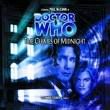
The Chimes of Midnight

An audio adventure featuring the Eighth Doctor and Charley

Written by Rob Shearman and directed by Barnaby Edwards

Polarity Rating: 3.5 out of 5

Imagine my festive frivolity when, randomly choosing my next Big Finish production to review in mid-December, a story presented itself that was set on Christmas Eve. Not only that, but the blurb on the back of the CD suggested it was some kind of Edwardian murder mystery. Sign me up, I said, and quickly went about listening to it so that I could post my review on this very day, Christmas Eve itself.

A quick word about Christmas stories and Doctor Who. When a story is set on Christmas, it never is about Christmas per se, but rather it involves some kind of an alien invasion set on Christmas Day (one obvious exception is the single episode aired on Christmas Day for "The Daleks' Master Plan," which I have not yet had the pleasure to listen to). There may be robot Santas wielding laser guns and a festive holiday party about to be torn to shreds by a tragedy a la The Poseidon Adventure, but I would love to see or hear a story that involves the concept of Christmas itself as a basis for the plot. (I would refer anyone seeking such a story to the recent Iris Wildthyme adventure, The Claws of Santa, which really hits the nail on the head in this department.) Such is the case with The Chimes of Midnight. There is a great deal of talk about Christmas pudding, one or two carols are sung in passing, but other than that the thing could have been set on Saint Swithen's Day and we would have had the same story.

Not that I have any huge gripes with most of the story. When the TARDIS materializes in the pantry of a country estate in 1906, the Doctor and Charley are involved with the comings and goings of five members of the household staff. Strangely, nothing is heard from the gentry having a Christmas party upstairs, and indeed when the Doctor tries to ascend to the upper levels of the house, he is deterred with unexplainable and uncharacteristic threats of violence from the staff. It's not long before a murder occurs and, in true Ten Little Indians fashion, the staff begin to be bumped off one by one, each at the grandfather clock's striking of the hour: the scullery maid, for instance, is found drowned in the washing basin, and the cook is found sprawled across the kitchen table, force-fed her infamous Christmas pudding to death. These events may seem like spoilers, except that the same characters inexplicably show up minutes later alive and well, oblivious to the fact that they were found murdered moments before. The Doctor and Charley and the listener, of course, are baffled.

This was the perfect setup for a wonderful cosmic mystery. Why are the characters admittedly unsure whether or not they could be the murderer? Why do the household duties of each of the characters change every time they return from the dead? Why do they recognize the Doctor as some kind of famous amateur sleuth? Through the first three episodes, I thought I had it all figured out: of course, I figured, the Doctor and Charley were stuck in some sort of land of fiction as in "The Mind Robber," where an author of whodunnits was constantly rewriting a draft of his latest murder mystery, never quite sure who the proper murderer should be in the end or even the right victim.

My solution, needless to say, was not the correct one. Unfortunately, the true solution to the mystery would have led me to give this story a 4.5 rather than a 3.5 if it didn't leave me scratching my head. I suppose there are fanboys and fangirls out there who love stories involving paradoxes and time folding in on itself, but these type of stories rarely work for me unless they're spelled out for me like I'm a nine-year-old (the old favorite "Blink" comes to mind). In all fairness, I could go back and listen to the last episode, but I just don't think that would be proper. Why go back and listen to a story and purposely look for the good things when the writer and/or director failed to get the point across the first time?

I rarely think this when listening to Big Finish stories, but this one would have been a wonderful televised story for Christmas Day. There were certain passages here that would have translated better on the screen, and the holiday element could have been used a bit more than it was. If Paul Cornell could translate his novel Human Nature so well on to the screen, I say let Rob Shearman have his pick of a few audio adventures, definitely including The Chimes of Midnight, and see what magic he can make of those. He is, after all, the writer who brought us Dalek, for some the epitome of the perfect Dalek episode in the new series.

If you're new to Big Finish (or to the Eighth Doctor adventures), I'm told by folks on the forums that The Chimes of Midnight is one of the best out there. I beg to differ. Pick up a copy of Sword of Orion or Storm Warning instead. Unless, of course, you're one of those fans who love to put the 10% of the missing pieces of a puzzle together yourself. In that case, perhaps you have a better imagination than I and more power to you.

Fun Facts:
  • The character names for Shaughnessy, the butler, and Mrs. Baddely, the cook, were derived from the names of the script editor and the actress who played the cook in the classic British show Upstairs, Downstairs.
  • These are not the only characters to glean inspiration from Upstairs, Downstairs; Edith, the scullery maid from The Chimes of Midnight, bears a striking resemblance to the feather-brained scullery maid Ruby in Upstairs, Downstairs.