Showing posts with label Novels. Show all posts

Tuesday, August 3, 2010

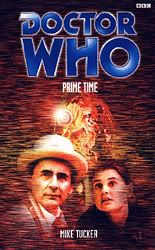
Prime Time

A novel featuring the Seventh Doctor and Ace

Written by Mike Tucker

Polarity Rating: 4.5 out of 5

As Doctor Who fans, we all have a kind of checklist that every good story should adhere to. Of course, one person's treasure is also another person's trash, so the fan who is totally into Rose and the Doctor slash fiction may have a completely different checklist than, say, your atypical fan who would like to have a common law marriage with "Pyramids of Mars" whilst categorizing "Time and the Rani" as something equal to or less than pond scum.

That being said, Prime Time managed to tick of every item on my own proverbial checklist. It has everything. It's a story so unbelievably perfect for Doctor Who that I think Mike Tucker should immediately be commissioned to pen the script for the current series. I simply cannot understand how I've read so much of the BBC's literary canon that this one slipped by me unnoticed all these years.

To wax eloquent about a story is one thing, and it would probably make for a boring review simply to do so for several paragraphs, so back to that checklist I was talking about earlier. Let me share with you the items on my fanboy checklist, and explain how this story delivered each item in spades. (For the record, the list below is not exhaustive by any means.)

1. The Totalitarian Society

The Doctor and Ace find themselves on the futuristic planet Blinni Gaar, where all does not quite seem as it should. The inhabitants (a melting pot of races) are a little too engrossed in watching television. TV's are everywhere: installed at the foot of bed frames, into dinner tables, and even into the dashboards of automobiles. For this society, television is the opiate of the people.

The term "totalitarian" commonly conjures up visions of a ruthless government, usually with some greedy dictator pulling the strings. No mention is ever really made of Blinni Gaar's government, and it's not even clear that they even have a government. But who needs a government when the people are clearly hypnotized by lousy reality television? This is a totalitarian society of a different color, and it's obvious to the Doctor moments after stepping out of the TARDIS that things on this planet are just not normal.

2. The Ruthless Despot

Tobias Vaughn. Harrison Chase. The Marshal of Solos. Where would we be without them? Some of them command a small regiment of heavies, others entire armies. The best of them serve as figureheads for the stories they appear in. (Am I the only one who thinks of Tobias Vaughn as the main villain in "The Invasion" instead of the Cybermen?) On Blinni Gaar, they have Lukos Vogol, Director of Channel 400, which is responsible for transmitting many of the programs which are transforming the viewing audience into couch potato zombies.

Vogol is a maniacal megalomaniac, intent on getting the highest ratings by hook or by crook, including murdering every member of the geriatric board of directors. He occupies an office at the top of the Channel 400 studios, drinking scotch and watching television programs while manipulating everyone around him. This sounds like a typical villain, until about halfway through the story we learn this guy is hatching plans with as many layers as an Outback Steakhouse Blooming Onion.

3. The Brutal Heavy

Vogol is working with the Zzinbriizi, a barbarian race of wolf men who have been surgically augmented with superior intelligence. These guys can usually think for themselves thanks to their new abilities, but their hunger for blood and instinct to hunt is often overpowering. They find themselves stuck between obeying orders (from more than one master) and their need to eat flesh.

Had this been a mediocre story, the list of baddies would stop at the Zzinbriizi, but it's clear from the beginning that they're only pawns in a complicated power struggle between Vogol and...

4. The Terrifying New Alien Race

If I were to bring up the highlight of this book, it would have to be the Fleshsmiths. They are the stuff of nightmares, and if this story ever was televised, the Weeping Angels would probably take the back seat to these guys. Once a happy, normal race, the Fleshsmiths' planet suffered a natural disaster which forced them to kidnap members of other races and cannibalize their body parts to create new bodies of their own.

If one were to make a science fiction remake of The Texas Chainsaw Massacre, the sets would be not unlike the Fleshsmiths' home planet. Author Mike Tucker goes into some detail into their flesh bank, where bodies are left mutilated, hanging, and still alive from hooks and chains. The Fleshsmiths themselves stay connected to their external resources via thick tubes that are grafted into their bodies. The tubes are filled with murky black liquid, and one could almost smell the stuff as it's described how it oozes from the pipes as they're connected and reconnected to their hosts' bodies.

The Fleshsmiths' prime directive is simply to survive, even if it means other races have to die - and suffer horribly - in the process. Their directive is a simple one that we've seen over and over, but their realization is unbelievably gruesome. Perhaps their cruelest scheme is to kidnap an innocent soul, surgically implant a camera into his skull (among other things), and force him to do any of a number of things against his human conscience. Tucker leaves the appearance of this creature to our imagination, and the most we get are the first impressions from anyone encountering this crime against nature.

5. A Great Realization of the Doctor

The Seventh Doctor is perhaps best known for being cunning and manipulative, even with his own companions. But how does he react when the shoe is on the other foot? Here the Doctor becomes a mouse inside a giant maze, forced to deal with one deadly reality after another. There even comes a point when his enemy gloats over the Doctor's inability to plan his way out of the situation.

Of course, without revealing any major spoilers, the Doctor turns the tables at the end. In Prime Time, though, we see him at both his most vulnerable and eventually his most manipulative.

6. A Vulnerable Companion

And speaking of vulnerability, Ace is not the bat-wielding force to be reckoned with that we've seen in the final episodes of the classic series. She comes off as expected as first (she befriends another young citizen of Blinni Garr who teaches her how to rock climb), but eventually she finds herself in the clutches of the enemy and is forced to endure torment about her past and her future.

I will not say more about what Ace does in this story, but Tucker bookends the story with an epilogue and prologue regarding Ace that are cryptic yet compelling. I'll be damned if I saw that coming.

7. A Recurring Villain

Recurring villains are not my favorite. Why read another Dalek story when we can get something fresh and interesting like the Fleshsmiths? It would probably ruin the first third of the story if I told you the identity of the villain here, but suffice it to say that it's the most shocking revelation of a returning enemy since Lawrence Miles' Alien Bodies.

And there you have it. Prime Time is a thing of beauty, a wonderful feast with all the perfect courses and ingredients. Perhaps its only problem (and the reason I didn't rate it a perfect 5) is that Mike Tucker's prose is a bit off when it comes to describing places and things; I found myself having to reread some passages, then forged on in slight confusion nevertheless because I couldn't get what he was trying to get across visually (the description of the Fleshsmiths notwithstanding).

If you're a Who fan with an internet connection and $15 in your bank account, there are far worse things you can spend it on. Undoubtedly one of the best Missing Adventures in recent memory.

Fun Facts:
  • If the name Mike Tucker sounds familiar, you're not mistaken. Aside from writing a number of Doctor Who novels (most of them featuring the Seventh Doctor), Tucker is known for his effects work for some of the Ninth Doctor's televised stories.
  • Prime Time is riddled with in-jokes regarding the history of Doctor Who. For instance, while promoting the idea of broadcasting a show featuring the Doctor, Vogol labels him a "cosmic hobo," a term often used to describe the Second Doctor.

Sunday, March 14, 2010

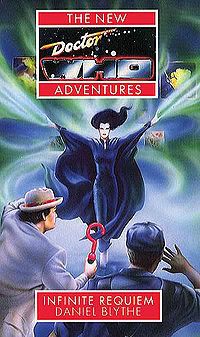
Infinite Requiem

A novel featuring the Seventh Doctor and Benny

Written by Daniel Blythe

Polarity Rating: 2 out of 5

The humans are at war with the Phractons on the planet Gadrell Major, where the conflict has razed the planet's cities to the ground. In the meantime, three strange and powerful people are exploring three different places in the universe, and all three are actually one omnipotent, powerful creature. All of this results in the Seventh Doctor and Benny finding themselves on Gadrell Major, amidst the conflict taking place and up against Shanstra, whose powers are culminating even as the war around her is coming to a bloody end.

Infinite Requiem is very well-written by Daniel Blythe, who was unfamiliar to me up until reading this book. The problem is that it brings nothing new or interesting to the table. Admittedly, I have been slacking off a little on posting these reviews, and I put this story down about a month ago, read another book and finished it, and picked up a third book before I sat down to write this review. I find myself in a fog, because there's little, if anything, memorable about this story.

The televised stories are rife with conflict between one alien race and another, or one colonized civilization and its unruly rebels. Sometimes it works, sometimes the story just fades into the woodwork. (Tell me what you can remember about "Colony in Space," for instance.) Infinite Requiem is a lot like that. We have a war between the human beings and the Phractons, a cyborg race who are all connected via a virtual electronic grid and house themselves in small flying pods; I was reminded of the Toclafanes in the contemporary Who stories "The Sounds of Drums" and "Last of the Time Lords." I liked the Phractons, and desperately wanted to learn more about them, but the story doesn't exactly pull us in that direction.

The antagonist is an ethereal being which has split into three separate entities, calling themselves Kelzen, Jirenal, and Shanstra. We see a lot of Shanstra, and learn that she can bend minds to make people do things against their will and pretty much do the standard stuff that any god-like omnipotent creature can do: you know, fly about, shoot energy bolts from her hands, that type of thing. Jirenal, definitely the most interesting of the group, makes his way to the Pridka Dream Centre, which is run by a race of psychic reptilians called, of course, the Pridka. The Dream Centre is another place I wanted to learn more about, but we are only treated to snippets of storyline from there in the first half of the book, and although the action culminates there in the end, the novelty has worn off and the Doctor's attempt to defeat Shanstra and prevent her from accomplishing the titular "infinite requiem" takes center stage.

I said earlier that this book had little, if anything, to remember it by, and I just remembered something. There's a glorious scene where Jirenal makes a young Pridka's head peel back and burst open before a white dove comes flying out of the corpse. Not that's the kind of cool powers I wanted to see more of. Also, the Seventh Doctor is up to his usual manipulative tricks, which gets him punched in the face in the end.

This sounds like a hated the book, but I didn't. I suppose the word "meh" would best summarize my feelings for it. Doctor Who seems to be saturated with stories about wars and villains who think they're gods. Naturally, it's all squared away by the Doctor in the end, and of course it's done in typical deus ex machina style. I find myself reading, listening, or watching stories that involve characters or concepts that are simply too complex for me to wrap my little mind around, like the Eternals in "Enlightenment" or the infamous "Ghost Light." Infinite Requiem was no exception. Perhaps it's just me, and if other fans enjoy this stuff, then more power to them!

Daniel Blythe began his writing career with Doctor Who and later moved on to better things. I wish him the best. He's obviously talented and can weave a good tale. I just hope he never comes near Doctor Who again.

Fun Facts:
  • Although the TARDIS' zero room was allegedly jettisoned in "Castrovalva," it reappears here.
  • Captain Cheynor appeared first in The Dimension Riders, also penned by Daniel Blythe. Blythe must not have liked him very much, as he pathetically kills Cheynor in the final pages.
  • There's a brief mention of the time-space visualizer seen in "The Chase." Apparently it's been recording all of the Doctor's adventures since its installment.

Monday, December 14, 2009

The Romance of Crime

A novel featuring the Fourth Doctor, K9, and Romana II

Written by Gareth Roberts

Polarity Rating: 4 out of 5

Season 17 is arguably the worst period of the Fourth Doctor's era, what with the uninspired "Destiny of the Daleks" (did we really need to see Davros again?), the boring "Creature from the Pit," and Doctor Who's failed attempt at pantomime in "The Horns of Nimon." I imagine Gareth Roberts truly wanted to challenge himself by writing a novel set between those aforementioned stories, or perhaps he's a fan of season 17 and just wanted to celebrate it. In any case, The Romance of Crime somehow feels like a season 17 story, except it turns out to be much better than most of the stories in that very season.

The flavor is in the description of the characters, with guards that wear red frockcoats, a judge who, if he had been portrayed on television, would have chewed the scenery to bits, and villains that seem like hilarious caricatures of some of the more forgettable baddies in Doctor Who's long history. The flavor of this era of the program also can be read in the description of the setting, a space station with meandering corridors in which the characters inevitably run back and forth in. And, perhaps best of all, the portrayal of the Doctor and Romana is crafted straight from the late era of the Fourth Doctor, with the usual banter between the two of them. Take, for instance, this quote from the Doctor as he barges into a control room filled with villains:

"Hello everybody. It's nice to see you again, Xais, and you Mr. Pyerpoint, and you charming Ogron gentlemen, and, ah, you must be the Nisbett brothers. You don't know me, I'm the Doctor, this is my friend Romana, and that's Mr. Stokes, and do you know unless you listen to me I think we're all going die."

It's as if Gareth Roberts was actually channeling Tom Baker. Try having any one of the other ten actors that have played the Doctor say that line, and it wouldn't feel right at all, not even if David Tennant gave it his best.

Most of the story unfolds aboard the Rock of Judgment, a space station which cruises the galaxy and functions as both a kind of galactic courthouse and prison. The captain, for lack of a better word, is a judge named Pyerpoint, who spends the first half of the story trying to keep order in true bureaucratic fashion after the Doctor and Romana arrive. The Rock is home to a number of interesting characters, including security chief Margo, who seems to suffer from erratic bouts of possession from forces unknown, and Menlove Ereward Stokes, the resident artist and winner of this story's most eccentric name. (Stokes spends much of the story cowering behind corners, whining about every situation he finds himself in, and trying unsuccessfully to hit on Romana. He reminds me very much of a heterosexual version of Dr. Smith from Lost in Space.)

We soon learn that Margo is slowly being taken over by the spirit Xais, an evil female mutant who had been executed at the Rock years earlier for slaughtering dozens of non-mutants, whom she calls Normals. Xais can kill human just by looking at them, but they don't just drop dead; they literally fold in on themselves in a grisly display of flesh and bones. Xais has her own allies, the Nesbitt brothers, intergalactic gangsters who look like Drew Carey and act like Gordon Ramsey. Oh, and the Ogrons make an appearance as well, and Roberts handles them much better than they way they were portrayed in "Day of the Daleks" and "Frontier in Space." (No spoliers there -- there's a drawing of an Ogron on the front cover.)

What Xais has planned I will not tell you. What I can tell you, however, is that it involves a number of allies and a tangled web of deviousness that I relished reading. What results is a typical "base under siege" story, with characters being split up, reunited again, and split up again into different combinations. Of particular note is K9's role in the story as he accompanies a rough undercover police agent who ends up taking a shine to the tin dog.

Xais' evil plot aside, the main attraction is reading about these characters rather than the way the story moves. Perhaps the plot itself is the story's weakest link, as it's all pretty straightforward, but it's the tasty ingredients in the story itself -- namely, the characters -- that make this stew particularly good.

This was Gareth Roberts' fourth novel for Virgin's Missing Adventures series (the first three were Seventh Doctor New Adventures) and he went on to pen a handful more and wrote three scripts for the new series, namely "The Shakespeare Code," "The Unicorn and the Wasp," and "Planet of the Dead." All three of these scripts lack much of the humor and rib-poking that fills The Romance of Crime (with some exceptions, particularly in "The Unicorn and the Wasp"), and I'm hoping that his upcoming installment for the Eleventh Doctor brings some of this back. He was certainly an asset to the novels published by Virgin, and I look forward to reading more by him.

Fun Facts:

  • Roberts brought the large, eccentric, and bald artist, Menlove Stokes, back in The Well-Mannered War and he later became a regular in the Benny New Adventures.
  • For this first time (I think) we're told that the Ogrons are from the planet Braah, where drastic changes in the climate caused the Ogrons to undergo an evolutionary hiccup. As a result, they're not unlike a cross between an ape and a koala bear.

Sunday, November 22, 2009

The Eleventh Tiger

A novel featuring the First Doctor, Barbara, Ian, and Vicki

Written by David A. McIntee

Polarity Rating: 3 out of 5

I've never been a very big fan of the historical epics during the First Doctor's era, so it was with trepidation that I opened The Eleventh Tiger. However, my fears were quickly allayed: the prose is descriptive and the characters (particularly the four regulars) are well-realized. McIntee uses masterful brush strokes to recreate China in 1865, and I was almost instantly sucked in.

But first, a bit of history. In 1865 China was still recovering from the Opium Wars, in which they lost to the British and were forced to tolerate the British occupation as they traded freely in opium and other goods. Among other things, China also ceded Hong Kong to the British. In the background of all this was a league of bandits known as the Black Flag Army, whose primary ambition at the time was to oppose the British. It's the Black Flag Army that's the catalyst of this story, although we later learn that, as usual, there are otherworldly powers pulling the strings.

As colorful as the book was, it dragged out for a bit in the beginning after the main characters are introduced and we discover that there's a British soldier in the city of Guangzhou who bears an uncanny resemblance to Ian. Did Ian return in the future? And why does this soldier not remember anything about his own life? The mystery is pretty compelling, since we all know he and Barbara eventually returned to their own time. But more on that a bit later. The story appeared to be taking the turn that most of the historicals did, with the TARDIS crew involving themselves in some tumultuous past event. Until, that is, we meet the abbot who is gearing up to take over the Black Flag Army. And the guy literally plucks out the eyeball of a dead deer and pops it into his mouth like a grape, but not before he orders one of his henchmen to cut off the nose and tongue of an allegedly insolent minion. And with this passage, the story takes a turn for the better.

Well, not all that better. McIntee's writing style continues to shine, and there are some absolutely fabulous passages with descriptions of hand to hand combat; this guy would have been an awesome choice to write a novelization of Kill Bill. There are some creepy terracotta soldiers that are possessed by alien energy and run amok, and the celestial activity leading up to the villain's master plan cause energy stored in rock to create images of ghosts. (Female ghosts, it should be noted, with long black hair that weep for dead lovers. I see some influence from the film Ringu in there somewhere.)

And then, dear reader, after a climactic scene in which Ian is going to shoot his future self to save Barbara's life, the story just takes a complete nosedive. We learn the story behind Ian's body double, and it's one of the most contrived plot points in recent memory. After leading us down the garden path for pages and pages, making the reader wrack his brains to figure out why a future Ian is in China in 1865 and why he's suffering from amnesia, we learn (spoiler alert!) that the "future" Ian is actually the "real" Ian's great grandfather. And they look like twin brothers! This has absolutely nothing to do with the alien menace lurking throughout the rest of the story and served only to insult the intelligence of the reader.

I have no complaints about McIntee's portrayal of the First Doctor, which is spot-on; there's a wonderful scene in which he engages in hand to hand combat that I could easily play out in my head despite the Doctor's obvious frailty. This is also the first novel, to my knowledge, in which we get to read about the inevitable affection between Ian and Barbara, and they even snog at one point. It was a bit of a shock, but ultimately quite understandable (particularly since they eventually marry, as we learn in The Devil Goblins of Neptune). Vicki seems a little under-utilized, as she spends most of the story hanging about in the background and developing a crush of her own on a local boy.

At the end of the day, the alien menace is vanquished and our heroes leave in the TARDIS. Unfortunately, the ending just seems a tad bit forced, as the solution to the problem appears out of nowhere. I do forgive McIntee for that, as the rest of the novel (sans the bit with Ian's double) is quite good.

Great writing or not, The Eleventh Tiger is not McIntee's best; he thrilled the socks off of me years ago with The Dark Path and impressed me again with The Face of the Enemy. But, particularly if you're a fan of the historical stories, you can't really go that wrong with this book. It beats the hell out of Sick Building anyway.

Tuesday, June 30, 2009

Sick Building

A novel featuring the Tenth Doctor and Martha

Written by Paul Magrs

Polarity Rating: 1.5 out of 5

After the televised series ended in 1989, Doctor Who fans became hungry for more, and the BBC sated their appetites with the release of a series of novels featuring both "new adventures" featuring the Eighth Doctor and "missing adventures" featuring the other seven. Many of the books were well-written, mature, and blasted some of the televised stories out of the water for their sheer imagination, characterization, and plotting.

After the BBC revived the television show in 2005, they began churning out books again, this time featuring the Doctor's ninth and tenth incarnations. BBC Books plans on issuing its 40th release of this series in September, 2009. The books themselves are sleek, eye-catching, and hardbacked. Sick Building is only the second I have read in the series and, although it will not be my last, it seems that BBC Books has sacrificed plot, characterization, and theme for some books that will look impressive on a collector's shelf.

The story's MacGuffin is the Voracious Craw, an unbelievably gigantic creature, not unlike those huge sand worms in Dune, that consumes all life on a planet by simply sucking up hordes of plant and animal life into its maw with some sort of tremendous sucking tornado. The Doctor is concerned that the Craw is decimating Tiermann's World, a small wilderness planet literally owned by the eccentric but brilliant Professor Tiermann and inhabited exclusively by the Professor, his wife, and their teenage son. The Doctor pays the Tiermanns a visit in their luxurious Dreamhome, which is swarming with the Professor's robotic inventions that serve the humans in every capacity imaginable: there is a quirky robot whose sole purpose is to serve cocktails, and there's another who exists simply to dispense medication to Tiermann's wife. The family is all too aware that in a day and half's time the Craw will destroy their Dreamhome, but it becomes increasingly apparent that Professor Tiermann is far too proud to leave behind his home and what amounts to his life's work. As the tension between the Doctor and Tiermann rises, the impending visitation of the Craw causes the Dreamhome and its robotic inhabitants to malfunction. Soon it's obvious that the Dreamhome itself, possessed by a computer consciousness gone mad, will stop at nothing to prevent the humans from leaving.

The premise here is actually quite thrilling; the Doctor and his allies find themselves assailed by such threats as fanged flying vacuums and a hungry horned bear-creature that finds its way into the mansion after the protective shields go down. All these elements are obstacles which get in the way of the party escaping the Dreamhome, while all this time the hours are counting down to the inevitable visit of the Voracious Craw and the destruction of everything within miles. This should have been a thrilling adventure, where the reader can never guess which characters will make it out alive. Unfortunately, the author injects several elements into the story that force it to fall flat on its face.

The idea of a mansion filled with artificial intelligence is intriguing, but how can one possibly visualize a tanning bed with legs and which can speak and form friendships? Or a presumably "female" vending machine named Barbara who develops a crush on the Doctor? Mind you, these are not simply incidental quirks in the story, but major characters that participate in much of the action. Fiction is supposed to ignite one's imagination, but I simply could not grasp the physical concept of a four-legged tanning bed running for it's life down a staircase with its human counterparts. All of this is not helped at all by the Doctor: you see, we know that robots, no matter how complex, do not have feelings. But the Doctor, with all of his wisdom, seems to sympathize with these creatures, and goes far out of his way to ensure their survival. This seemed to work rather well in the televised adventure "Robot," in which the titular creature was conflicted between its feelings of friendship with Sarah Jane and its programming to destroy, but the robots in Sick Building were created merely to serve in menial capacities, and it just spirals into downright silliness.

Aside from the Doctor and Martha, the remaining three characters have little redeeming value; Professor Tiermann is obviously insane and unsympathetic, his wife Amanda serves no other purpose than to cry and become a burden to the escapees, and his son Solin is a two-dimensional teenager who develops an annoying crush on Martha. How are we supposed to care about these people?

And then there's the conclusion, in which the Doctor tries stop the Voracious Craw with a plan involving soda pop. It's tempting to simply describe this right here to show how ridiculous it is, but for the sake of spoiling it for anyone wanting to read this book, I will stop here.

There are, I admit, some good points. There's a clever little plot twist involving a secret harbored by one of the characters, and an amusing scene where the Doctor distracts a carnivorous scavenger by singing Queen's "Bohemian Rapsody." Unfortunately, these highlights are not enough to save an insipid and contrived storyline.

If the other entries in this series of novels are anything like this, it's clear that BBC Books is targeting younger, pre-teen fans of the show. The whole thing seems to have the same prose as a Choose Your Own Adventure storybook, albeit without the reader making any choices. I'm all for appealing to young readers, but what happened to the descriptive and darker stories we saw with the BBC Books' missing adventures and those with the Eighth Doctor?

I will definitely shelve Sick Building among my collection, but I doubt I will ever read it again. I cannot say the same for the televised series, which wisely steers away from lovesick vending machines. Yes, there are some things that simply cannot be realized seriously on screen, and I am more than willing to turn off some of my logical thinking while reading a story, but Sick Building seems to take that for granted for much more than its worth.