Showing posts with label Audio Stories. Show all posts

Saturday, October 16, 2010

Arrangements for War

An audio adventure featuring the Sixth Doctor and Evelyn

Written by Paul Sutton and directed by Gary Russell

Polarity Rating: 1 out of 5

The problem with randomly picking stories to review is that you obviously do not listen to them in order. Big Finish often releases three or four stories in an arc, and although they may be enjoyed independently, there are elements that overlap in consecutive stories (see my review of The Key 2 Time: The Destroyer of Delights as an example). Another issue is that you can pluck a story from Big Finish's library and learn something about a companion you're not very familiar with, which I think may have been part of my problem with this one.

The last story I listened to (and enjoyed) featuring Dr. Evelyn Smythe was her first appearance in The Marian Conspiracy. There she was presented as a hard-as-nails history lecturer capable of standing up to the Sixth Doctor's usual bravado. I liked her, and found it was refreshing to have an elderly companion, not to mention someone a little reminiscent of Tegan, albeit a bit less annoying. In the opening of Arrangements for War, Evelyn is recovering from a loss she suffered in the previous story, and she later falls in love with a gentleman who proposes to her. It was a sudden change from what I had perceived the character to be, and I suspect there has been a lot of character development since The Marian Conspiracy.

Hoping to give Evelyn's emotions a rest, the Doctor brings her to the planet Vilag, where two rival countries are about to celebrate the marriage of Princess Krisztina and Prince Victor. The marriage is an arranged one, as well as a political move to make peace between the two nations. Obviously there are some dissenters, the most prominent being Plenipotentiary Suskind, but the Doctor assures us all will be well again in a couple weeks time when the planet will be invaded by an alien race which will be defeated by all the nations on Vilag joining together. Their victory will solidify their alliance and peace will reign eternal.

I despise when I ask people how a film or television show was and their one-word review is something like "boring" or "stupid." But you cannot imagine how tempting it is to simply slap this CD with a "boring" sticker and call it a day. The first episode consists of the Doctor's consoling Evelyn and giving her the usual "I can't change the bad things that have happened" lecture, followed by talking about preparations for the upcoming wedding on Vilag. Then the Doctor puts his foot in it when he accidentally talks Krisztina out of marrying Victor and sticking with her true boyfriend, Corporal Reid. This means, of course, that the marriage that would mark the first step toward peace may be called off, so that means the Doctor has inadvertently changed their history. And that, my friends, is the stunning cliffhanger at the end of the first episode.

It didn't get better with the second episode. The aforementioned romance between Evelyn and Governor Rossiter continues, and the Doctor tries to dance around the fact that he's changed history by trying to get the wedding back on track. Which brings me to a interesting point: not long ago I was watching "Pyramids of Mars," in which the Doctor and Sarah are as nonchalant as ever to bring up the fact that they're time travelers to save the planet from Sutekh, yet in this story everything could have been averted if the Doctor had just come out and told the damn truth! I found this relentlessly irritating, which was doubled by the Doctor's postulations on love. Frankly I couldn't believe this was a Doctor Who story, not to mention a Sixth Doctor story. They even have the Doctor secretly passing love letters between Krisztina and Reid, as if he sits between them in study hall.

There are a number of other implausible happenings, including the imprisonment of the Doctor and Evelyn for reasons unknown (or perhaps I just wasn't paying attention, which was a task in and of itself). We are treated to voice overs of newscasters to explain the passing of time. Eventually the alien invaders arrive and the least impressive invasion in Doctor Who history ensues. The story concludes with the Doctor suddenly realizing that his actions do have consequences, and it's sort of the mirror image of that scene at the conclusion of "Waters of Mars."

Perhaps I'm not the right person to review this story. Perhaps I was just expecting something a little more exciting like the stuff Big Finish has been churning out lately. There was very little in this story that compelled me...heck, I don't think there was anything in it that compelled me. Mind you, the acting was fair. I have a feeling that there are people out there who are passionate about this story, and I'll bet anything they're the same folks who loathe "Love and Monsters," a story that's particularly close to my heart.

This is the first story I've heard by Paul Sutton. One of his other works, No More Lies, is currently sitting on my bookshelf, still in its plastic wrap. After listening to Arrangements for War, I suspect No More Lies will maintain its plastic status. I'm sorry, Paul Sutton, but I've read some of the other reviews out there and some fans seem to like this type of story. Obviously, I don't.

I like my Doctor Who to have a little more action, cliffhangers in which the characters are in danger, or some plot that doesn't seem to have been pulled from a soap opera set in a magical land of fairy tales. Even when the story did head in that direction (the alien invasion), it was so slapdash and quickly over that I hardly even noticed it. The conclusion of the story seems as long as The Return of the King, with the Doctor philosophizing on how his travels have changed so many lives, often for the worse, as Evelyn pats him on the hand with hollow reassurances. This is not something I can see the Doctor allowing himself to bring to the surface, particularly the Sixth Doctor. My Sixth Doctor is arrogant, funny, and sometimes a little too quick to open his mouth. This was not the same Doctor or the same Evelyn that I really enjoyed in The Marian Conspiracy.

I probably will not be listening to Arrangements for War ever again, although I will keep it for the sake of being a completest. I do have a friend I will recommend it to, though, and I truly hope that he gets more out of it than I did. It is not, I dare say, a complete waste.


Thursday, April 1, 2010

Memory Lane

An audio adventure featuring the Eighth Doctor, Charley, and C'rizz

Written by Eddie Robson and directed by Gary Russell

Polarity Rating: 4 out of 5

After listening to my somewhat scathing podcast review of "The Keeper of Traken," a friend suggested that I watch something that was more of a "romp," perhaps something with Daleks. I was inclined to be offended, but then I reviewed my recent writ-up of Infinite Requiem (see below), and now I can't help but think the time is ripe for such a "romp." Memory Lane turned out to be a happy respite.

The Doctor, Charley, and C'rizz (pronounced "care-rizz") dematerialize in a typical English urban neighborhood, but of course everything is not as it seems. Each one of the homes along the seemingly deserted street is occupied by the same elderly woman and her grandson Tom. Why does Tom look much older than he acts? Why does his nan not seem to blink an eye when the TARDIS materializes in her parlor? Why do the same programs play over and over again on the telly? And why does the ice cream man seem so sinister?

By the time the first episode of Memory Lane draws to a conclusion, there's an aftertaste of the confusing M.C. Escher staircases in "Castrovalva," except I'm happy to say that the confusion is eventually explained in this case and in a way that seems quite plausible within the parameters of a science fiction tale. (In case you couldn't tell, I'm not exactly a fan of the "magic" worked into some of the stories during John Nathan-Turner's time on the show.) Of course, this being a Doctor Who story, we know that there have to be sinister minds at work here (more on that later), but the silver lining of this play is the feeling that there's something wrong just beneath the surface, that the seemingly innocuous characters within this universe may not be hiding anything, but perhaps there's a greater force pulling the strings.

If you've read this far and haven't listened to the play, I recommend you stop here, as spoilers abound from here on in. Otherwise (or if you just don't care), please read on. Halfway through the story, we learn that the environment is like a terrarium constructed by alien forces for the purpose of imprisoning Tom, who is not really a six-year-old boy but an astronaut whose vessel crash-landed on the planet decades before. The environment has constructed itself around Tom's memories, using nano-technology to place him in a time and place which he has fond memories of (thus the title Memory Lane). As a result, Tom is inexplicably unaware that he's imprisoned, and has been living out decades playing with Legos in his nan's home.

Once all of this is more or less explained, the environment begins to affect both the Doctor and Charley, with amusing results: Charley believes she's at home with her mother in 1906 (conveniently adorned with 1920's amenities) and at the conclusion of the third episode the Doctor is stuck in a loop in which he believes to have solved the dilemma and explains it all to his companions.

Part of the charm of Memory Lane is that the Doctor and his friends aren't really up against some malevolent force hellbent on conquering the universe or having revenge against the Doctor; this time, it's just a pair of individuals with seemingly innocent intentions, albeit a little misplaced. The "villains" in this case are a pair of bumbling scientists named Argot and Mawvik who are in charge of entertainment on their planet. The problem here is that although their technology is so advanced that it can convince astronaut Tom he's six years old and in his nan's flat, they still have no inkling how to record video images. The Doctor saves the day by introducing them to recording technology, allowing them to record Tom's arrival for prosperity and, as a result, they free him into the Doctor's capable hands.

Eddie Robson is perhaps most popular for his work on Big Finish's Benny Summerfield adventures, although Memory Lane is one of a handful of Doctor Who stories he's written. In his notes on the story, he explains that he enjoys putting his characters in situations where there are odd juxtapositions, such as the phonograph in "The Time Meddler" or the spaceships disguised as Edwardian racing yachts in "Enlightenment." He delivers this eerie juxtaposition in spades with Memory Lane. Going back to my earlier comment about this play being a bit of a "romp" (oh, how I hate using that word in a review!), Robson admits that this is a story without any kind of literary metaphor: it just is what it is!

As with many Big Finish entries, the story seems to prattle on a bit; I found myself looking at my watch through the fourth episode. However, the first two episodes are solid gold, as this is where most of the story's mysterious flavor comes from. The score is also very well done, although I couldn't help but think it sounded almost a little too similar to American Beauty.

It may just be a romp in the form of an audio Rubik's cube, but this romp is just about worth the price of admission.

Fun Facts:
  • In Charley's flashback sequence, her mother mentions Edith the kitchen maid. If she sounds familiar, that's because she was the catalyst for all the action in The Chimes of Midnight.

Thursday, December 24, 2009

The Chimes of Midnight

An audio adventure featuring the Eighth Doctor and Charley

Written by Rob Shearman and directed by Barnaby Edwards

Polarity Rating: 3.5 out of 5

Imagine my festive frivolity when, randomly choosing my next Big Finish production to review in mid-December, a story presented itself that was set on Christmas Eve. Not only that, but the blurb on the back of the CD suggested it was some kind of Edwardian murder mystery. Sign me up, I said, and quickly went about listening to it so that I could post my review on this very day, Christmas Eve itself.

A quick word about Christmas stories and Doctor Who. When a story is set on Christmas, it never is about Christmas per se, but rather it involves some kind of an alien invasion set on Christmas Day (one obvious exception is the single episode aired on Christmas Day for "The Daleks' Master Plan," which I have not yet had the pleasure to listen to). There may be robot Santas wielding laser guns and a festive holiday party about to be torn to shreds by a tragedy a la The Poseidon Adventure, but I would love to see or hear a story that involves the concept of Christmas itself as a basis for the plot. (I would refer anyone seeking such a story to the recent Iris Wildthyme adventure, The Claws of Santa, which really hits the nail on the head in this department.) Such is the case with The Chimes of Midnight. There is a great deal of talk about Christmas pudding, one or two carols are sung in passing, but other than that the thing could have been set on Saint Swithen's Day and we would have had the same story.

Not that I have any huge gripes with most of the story. When the TARDIS materializes in the pantry of a country estate in 1906, the Doctor and Charley are involved with the comings and goings of five members of the household staff. Strangely, nothing is heard from the gentry having a Christmas party upstairs, and indeed when the Doctor tries to ascend to the upper levels of the house, he is deterred with unexplainable and uncharacteristic threats of violence from the staff. It's not long before a murder occurs and, in true Ten Little Indians fashion, the staff begin to be bumped off one by one, each at the grandfather clock's striking of the hour: the scullery maid, for instance, is found drowned in the washing basin, and the cook is found sprawled across the kitchen table, force-fed her infamous Christmas pudding to death. These events may seem like spoilers, except that the same characters inexplicably show up minutes later alive and well, oblivious to the fact that they were found murdered moments before. The Doctor and Charley and the listener, of course, are baffled.

This was the perfect setup for a wonderful cosmic mystery. Why are the characters admittedly unsure whether or not they could be the murderer? Why do the household duties of each of the characters change every time they return from the dead? Why do they recognize the Doctor as some kind of famous amateur sleuth? Through the first three episodes, I thought I had it all figured out: of course, I figured, the Doctor and Charley were stuck in some sort of land of fiction as in "The Mind Robber," where an author of whodunnits was constantly rewriting a draft of his latest murder mystery, never quite sure who the proper murderer should be in the end or even the right victim.

My solution, needless to say, was not the correct one. Unfortunately, the true solution to the mystery would have led me to give this story a 4.5 rather than a 3.5 if it didn't leave me scratching my head. I suppose there are fanboys and fangirls out there who love stories involving paradoxes and time folding in on itself, but these type of stories rarely work for me unless they're spelled out for me like I'm a nine-year-old (the old favorite "Blink" comes to mind). In all fairness, I could go back and listen to the last episode, but I just don't think that would be proper. Why go back and listen to a story and purposely look for the good things when the writer and/or director failed to get the point across the first time?

I rarely think this when listening to Big Finish stories, but this one would have been a wonderful televised story for Christmas Day. There were certain passages here that would have translated better on the screen, and the holiday element could have been used a bit more than it was. If Paul Cornell could translate his novel Human Nature so well on to the screen, I say let Rob Shearman have his pick of a few audio adventures, definitely including The Chimes of Midnight, and see what magic he can make of those. He is, after all, the writer who brought us Dalek, for some the epitome of the perfect Dalek episode in the new series.

If you're new to Big Finish (or to the Eighth Doctor adventures), I'm told by folks on the forums that The Chimes of Midnight is one of the best out there. I beg to differ. Pick up a copy of Sword of Orion or Storm Warning instead. Unless, of course, you're one of those fans who love to put the 10% of the missing pieces of a puzzle together yourself. In that case, perhaps you have a better imagination than I and more power to you.

Fun Facts:
  • The character names for Shaughnessy, the butler, and Mrs. Baddely, the cook, were derived from the names of the script editor and the actress who played the cook in the classic British show Upstairs, Downstairs.
  • These are not the only characters to glean inspiration from Upstairs, Downstairs; Edith, the scullery maid from The Chimes of Midnight, bears a striking resemblance to the feather-brained scullery maid Ruby in Upstairs, Downstairs.

Sunday, November 29, 2009

Three's a Crowd


An audio adventure featuring the Fifth Doctor, Peri, and Erimem

Written by Colin Brake and directed by Gary Russell

Polarity Rating: 3.5 out of 5

After listening to this story, I really have to admit that there was nothing particularly extraordinary or original about it. There's a stranded colony of earthlings, a lot of people getting separated and running up and down corridors, and elements of the story seem to have lifted directly from films like Alien and The Island. All that being said, I still have to admit that it has everything that a halfway decent Doctor Who story has, and I have to laud it on that fact alone, as so many of the Big Finish stories seem to try to do something new and innovative and fall flat on their face (Minuet from Hell comes to mind).

The setting is space station Earth Colony Phoenix, stranded in space and cut off from the home planet, still attempting to terraform the unnamed planet below. The station itself is apparently huge, but houses a minimal number of colonists, and all of them are forced to live in solitary living quarters, never mingling with more than one other colonist at a time. The colony seems more like a prison ship, with the colonists suffering from severe agoraphobia (thus the title). Earth Colony Phoenix is headed by a woman named Auntie (perhaps hearkening back to Mother from Alien?), and she is played with steely coolness by Deborah Watling, whom most of us will know as Victoria during the Second Doctor's era. Ms. Watling has changed quite a bit over the years, and when I saw her hosting one the documentaries on missing episodes as part of the Lost in Time boxed set, I was taken aback at how stoic and somehow cruel she seemed, not unlike a poor man's Anne Robinson.

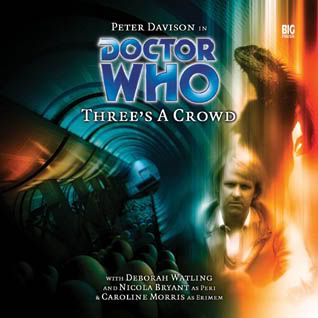
But I digress. The Doctor and his companions arrive as usual (with Erimem still feeling a bit of angst left over from their last adventure), and we learn that, unbeknownst to most of the colonists, Space Station Phoenix has been infested by a lizard-like alien race called the Khelllian (three L's, that's not a misspelling). The infestation becomes apparent when the TARDIS crew comes across a room filled with large slimy eggs; look closely at the CD cover art and you can see them. Again, inspiration from Alien looms.

I will not tell you what the Khelllian are up to and why they are being aided by Auntie, but the cliffhanger at the conclusion of the second episode is spine tingling; I really didn't see that one coming! There are three other colonists we meet: Bellip, Laroq, and Vidler, and they're pretty much indistinguishable except for the fact that Bellip is a high-strung female and Vidler seems to be a little more headstrong. The three characters were likely added to the mix to provide company to Peri and Erimem, who almost instantly break away from the Doctor and are involved in their own subplots. (There's also an insipid little romance between Bellip and Laroq, but this subplot seems a little forced and pads the story to its detriment, although it is helpful to understand the isolated lives the colonists are living.)

I have listened to about 25 Big Finish stories so far, and while Three's a Crowd doesn't stand out as one of the best, I really cannot say many bad things about it. Again, the lack of originality didn't seem to bother me, since this formula has worked so well in episodes like "The Ark in Space" and "The Macra Terror." I can say that the second half of the last episode was rushed and confusing, with all of the characters struggling to arrive at a fixed point while a time bomb counted down the seconds. How some of them survive eludes me (the story relies a little heavily on the convenience of transmat technology), and there's a final scene involving a hidden explosion that seems a little tacked on, but the resulting squishy sounds effects that were fun.

Deborah Watling is chillingly wonderful as Auntie, Peter Davison gives an adequate performance as the Doctor, and Nicola Bryant outshines her television performances as Peri. Caroline Morris as Erimem is a true joy, however, and I look forward to listening to more adventures with her. I've only listened to one Erimem adventure (The Eye of the Scorpion, her first one) and look forward to hearing more. She seems to be a carbon copy of Leela from the classic series, but it's fun to listen to her interact with Peri rather than just stick in her in the TARDIS to let the Doctor do his Professor Higgins magic again. Also, to my knowledge this is the only story in which the Doctor presents one of his companions with the option of staying behind to help the survivors and she turns him down, preferring a life in the TARDIS.

Kudos also goes to Gary Russell, who did a fine job recreating an eerie, desolate space station. Russell has come under fire from some fans for his lacklustre writing and his insistence on bringing back old villains, but I've enjoyed almost everything he's done for Doctor Who.

Three's a Crowd would be a great recommendation for Big Finish fans, and I am tempted to recommend it to fans who don't listen to the audio adventures because it hearkens back to the classic series so well. Just don't eat anything while you're listening to it.

Thursday, August 13, 2009

The Key 2 Time: The Destroyer of Delights

An audio adventure featuring the Fifth Doctor and Amy

Written by Jonathan Clements and directed by Lisa Bowerman

Polarity Rating: 2.5 out of 5

Big Finish's three-part "Key 2 Time" series is, in a way, a sequel to the six stories of the Fourth Doctor's era involving the Doctor's quest to recover the six missing segments of the Key to Time, reassemble them, and defeat the evil Black Guardian. On the 30th anniversary of the series, Big Finish has added three new stories involving the same premise, including a new companion, but this time with the Fifth Doctor.

The second installment, The Destroyer of Delights, is a standalone adventure in that you don't need to listen to the first installment, The Judgment of Isskar, to understand what is going on (I jumped full into it purposely knowing nothing about the first story). The Fifth Doctor has been joined by Amy, a new companion who has apparently been incarnated by forces unknown into a humanoid entity to help the Doctor in his quest. One of Amy's talents is that she can sense the presence of a segment by instinct alone, much like the contraption used by the Doctor and Romana in the classic series (you know, that plastic wand that sounded suspiciously like a radiation detector). Also, Amy adds an extra element to the narrative as a "newborn" entity: she doesn't understand emotional concepts like pain, enjoyment, or sadness. I have to admit that this does not add much to narrative structure or enjoyment of The Destroyer of Delights, and she simply reminded me of Lieutenant Commander Data from Star Trek: The Next Generation. Granted, of course, I have not yet heard her contributions to the first and third installment of the series.

Since The Destroyer of Delights was my first foray into this trilogy, I had a minor quibble right from the start: apparently the Doctor has already assembled the first four of the six segments in the very first story! To my knowledge, The Judgment of Isskar is a full four-part story (as opposed to four shorter stories), but I cannot understand why the producers chose to split the Key to Time into six segments for three stories when they could have split it into three segments (or, alternately, split it into six segments with six two-part stories). Then again, maybe I am jumping the gun here.

But back to the meat and potatoes. The story opens with the Doctor and Amy looking death in the face as the TARDIS is about to engulfed by the sun, when an unknown power freezes the TARDIS in space and time, saving their lives. Their knight in shining armor turns out to be the Black Guardian, whose powers have atrophied since the Key was broken up. He is willing to aid the Doctor in his quest, as the loss of the Key to Time would, in essence, mean the end of his existence and his possible domination of space and time.

I really enjoyed the surprise addition and handling of the Black Guardian in this story. When we last saw him in "Enlightenment," he was as evil and hellbent as the Daleks, but here we come to understand him not as the embodiement of all that is evil, but all that is rebellous and chaotic as well. The White Guardian, he explains, is the embodiement of all that is structured and lawful, like dinner with your mother-in-law or the legalization of marijuana (that second example is my own). The Black Guardian is played excellently by David Troughton, son of Patrick Troughton, and we saw David as early on as "The Curse of Peladon" and as recently as "Midnight." And yes, he sounds almost exactly like his father.

What with the Key to Time broken and dwindling in power, the Black Guardian is unable to locate the fifth segment: his intuitive powers seem to point him to three different locations in time and space (including 9th century Sudan), but he simply cannot pinpoint where or when it could be. Amy is in a similar quandary. This is the point when, through means and reasons I cannot understand after multiple listenings, the Doctor and Amy literally drop out of the sky in 9th Century Sudan.

Amy finds herself in the estate of Lord Cassim, who has been evading the taxman for the last two years by hoarding gold and giving it instead to an ominous-sounding alien who is hiding out in his crash-landed ship. It took me a while to realize that Cassim is actually the Black Guardian in human form; on a second listening, it occurred to me I was supposed to realize this immediately once Cassim was introduced, but Jonathan Clements tries to convey this by a single subtle line. I had initially gone almost three-quarters through the story before realizing the characters were one and the same. Again, maybe it's my own ignorance and short attention span that failed me here, but it really affected my enjoyment of the story the first time through.

The Doctor winds up in the desert, where he is helped by nomads and eventually takes refuge with the Legate of the Caliph, a tax collector who is none other than the White Guardian himself, also trapped in human form on Earth because his powers, like his counterpart's, have atrophied. Of course, the White Guardian is desperate for the Doctor to find all the segments of the Key to Time, as he is stuck in human form until it can be reassembled.


The Destroyer of Delights suffers from the problem that is evident in so many Big Finish productions: the first two or three episodes are all dragged out with exposition, introducing new characters with uninteresting subplots, while the fourth episode often tends to be a little anti-climactic by the time it's all wrapped up. The real villian in the story is the ominous Djinni, an alien stranded on Earth after his ship made a crash-landing. The Djinni is using the Black Guardian to collect gold to power the ship, but doesn't do much of anything throughout the entire story other than shout and provide an alien spacecraft for all the action in the end.

Unfortunately, I do not have a lot of positive things to say about this story other than the performances by David Troughton and Jason Watkins as the two Guardians are a joy to behold; the bits between them steal the show. Even Peter Davison seems to be just going through the moves, although since I'm not particularly a fan of the Fifth Doctor I'm a little biased. There's a cliched romance between a servant girl and a prince, and Amy spends much of the time acting bewildered and, in classic Doctor Who companion fashion, requires much of what is going on to be explained to her.

If one is looking for an excellenet science fiction adventure, my recommendation is to look elsewhere. One interesting point, though: the character of Lord Cassim, whom the Black Guardian is masquerading as, was an actual ruler in Sudan. He was made infamous in the history books for his mysterious hoarding of gold. I like the fact that Jonathan Clements nipped a tidbit of history to put in his story, but I wish he could have tried harder when delivering the goods.